It might be solar storage in an outbuilding, backup power in a basement or a bank at a cabin you visit twice a month. The DBB mounts beside the pack, reads its BMS, and watches every cell and every thermistor around the clock, with a log you can play back.
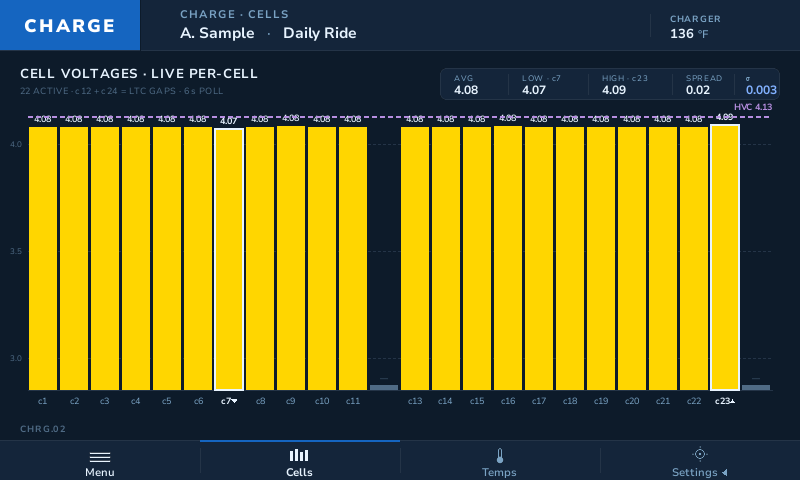
CHRG.02 Every cell, live, with the lowest and highest marked and the spread across the pack.
Each cell's voltage, live, with the lowest and highest marked and the spread across the bank tracked, so a cell drifting out of line shows up early.
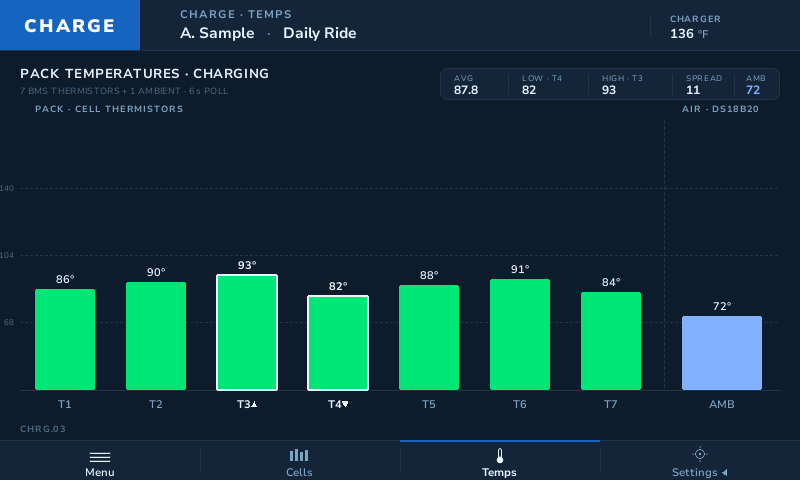
Every pack thermistor and the air around the bank on one screen. A sensor that isn't fitted reads "No input", so a missing signal never looks like a cold one.
Current, power, energy in and the charger's temperature whenever the bank charges.
When the BMS trips a cutoff or a thermistor passes its limit, the DBB names the cell or sensor and an alert sounds.
The DBB watches the bank continuously and logs the whole time, with every cell and every thermistor recorded row by row.
Nobody has to remember to start a session, and a gap in the record means something happened worth looking at.
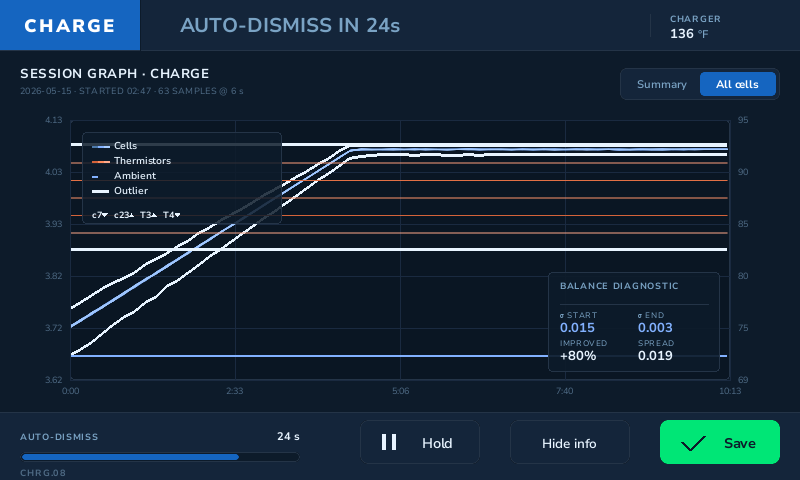
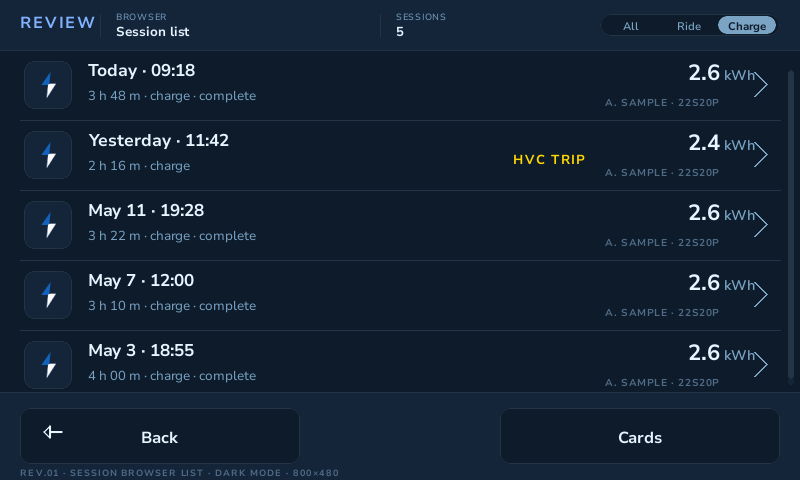
Something happened overnight? Open the log and replay it through the live screens.
Pause, skip 30 seconds either way, or run it at up to 30 times speed. Graph any stretch, zoom in with one finger, and copy the record to a USB stick as CSV for your own files or whoever services the bank.
Remote installs report to a central dashboard, so you can keep watch on several battery banks from one place and see which one needs attention. See it on a farm with seven banks.
Every install on one dashboard, with the ones that need attention easy to pick out.
Open any install's live readings, every cell and thermistor, from wherever you are.
The continuous log and playback are there from the dashboard too, so you can see what led up to an alert.

Run it in Lite and the DBB reads the BMS and charger but can't change a setting.
A customer, a tenant or a new technician can check the bank without any way to change its limits. Full mode, with settings from the touchscreen inside safe bounds, is there when you need it.
It takes 12 V or USB 5 V. If power drops, a LiPo backup gives it time to save everything and shut down cleanly. When power comes back and the BMS wakes, it finds the devices on its own.
It reads, displays and logs. It doesn't control the bank and it isn't a safety system, so the BMS and your installation's protection stay in charge of that.
The DBB works with many popular BMS, charge management and EV drive systems, with more integrations being finalized. Tell us your system on the form below and we'll tell you where it stands.
Yes. Each install reports to the central dashboard, and you can open any one of them from there.
We built the DBB for our own electric motorcycles in Detroit. See the rider's version. A battery bank asks the same questions of a pack, from a shelf instead of a frame.
Early-release tester units are planned at $699. Everyone on the waitlist saves $99, whichever DBB they choose: an early-release tester unit now, or DBB Lite, Full, Pro or Desktop when they're released. Tell us about your install, and we'll tell you whether the DBB can read it.
